SEO vs AEO vs GEO vs AIO: What's the Difference (and Which One Do You Need)?
 Sai PrasadSeptember 20, 20268 min read
On this page
Introduction: Search Has Changed
A few years ago, getting found online meant one thing: ranking on Google's first page. Today, people also ask ChatGPT, Gemini, Perplexity, or read Google's AI Overview at the top of the results, often without clicking any website.
The scale is large. ChatGPT reached 900 million weekly active users in February 2026, more than double its user base from one year earlier . At the same time, AI summaries are changing how people click. In a Pew Research Center study, users clicked on traditional search result links during 8% of visits when an AI summary appeared, compared to 15% of visits without summaries. Users also rarely clicked on sources cited within the AI summaries themselves, doing so in just 1% of visits.
That shift created a wave of new acronyms: AEO, GEO and AIO, alongside the classic SEO. Let's break each one down simply.
The Quick Answer (TL;DR)
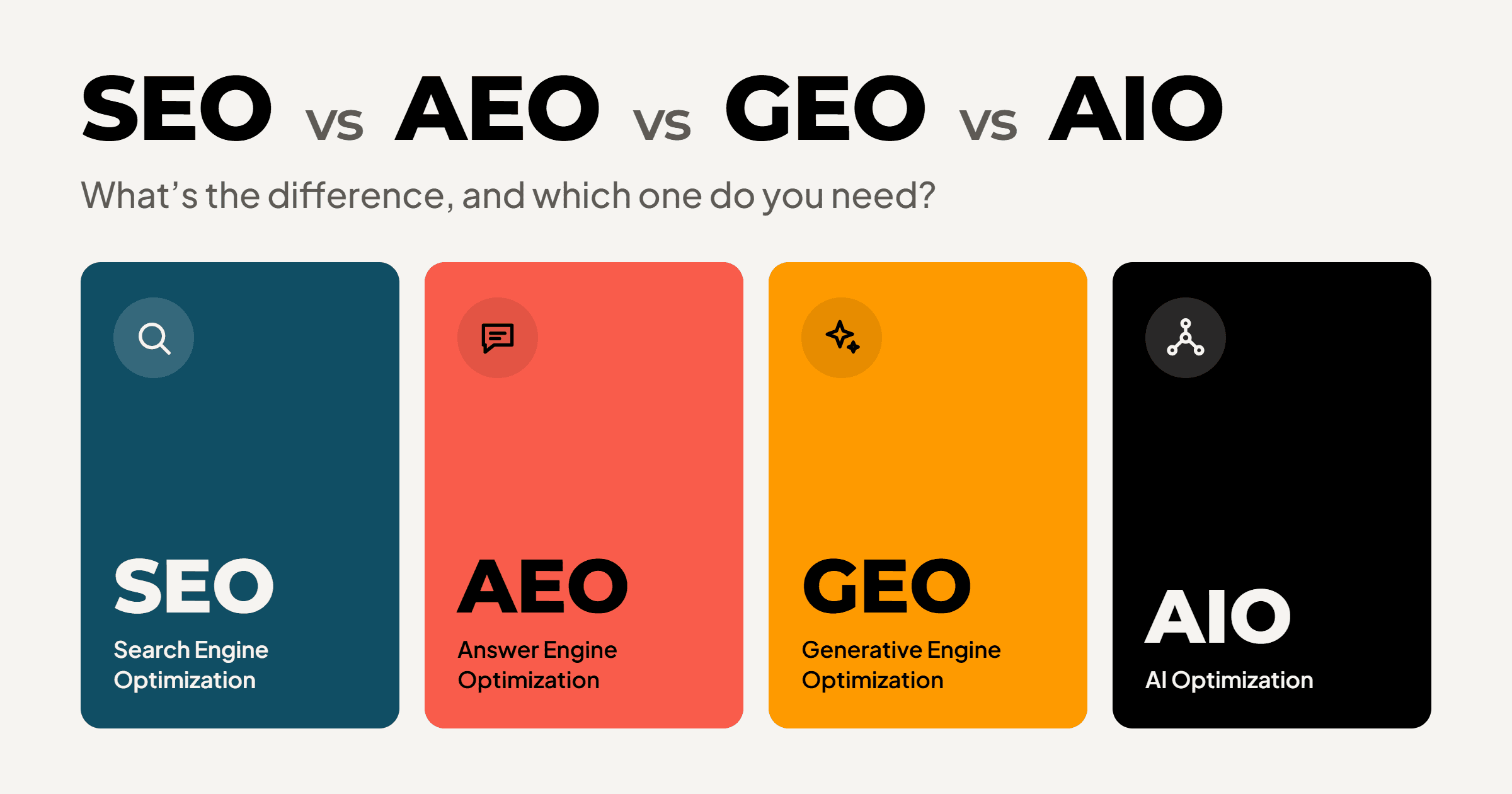
SEO (Search Engine Optimization): Helps your pages rank in search results so people click through.
AEO (Answer Engine Optimization): Helps your content become the direct answer, such as a featured snippet or voice assistant reply.
GEO (Generative Engine Optimization): Helps your content get cited or mentioned inside AI-generated answers from tools like ChatGPT and Perplexity.
AIO: A confusing term with two meanings: AI Optimization (an umbrella strategy) or Google AI Overviews. Always define it before using it.
1. What Is SEO (Search Engine Optimization)?
SEO is the original discipline and still the foundation of everything else. It's the practice of improving your website so search engines like Google and Bing can find, understand, and rank your pages.
SEO focuses on:
Keyword research (what people type into search)
Technical health (site speed, mobile-friendliness, crawlability)
Quality content that matches search intent
Backlinks from trusted websites
Goal: Rank higher → get more clicks → get more traffic.
How you measure it: Rankings, organic traffic, click-through rate (CTR).
Example: Someone searches "best running shoes for flat feet," and your article appears in position #2. They click and read.
2. What Is AEO (Answer Engine Optimization)?
AEO is about structuring your content so a search engine or assistant can pull it out as the answer to a question. It focuses on making your content the answer that engines deliver to users, whether through featured snippets, voice assistant responses, or AI-powered chat results.
AEO isn't brand new. The concept emerged around 2014-2015, coinciding with Google's introduction of features like the Knowledge Graph and featured snippets. [4] Voice assistants made it even more important, because Google Assistant, Siri, and Alexa all resolve voice queries to a single spoken answer .
AEO focuses on:
Question-based headings (e.g., "How long should I boil an egg?")
Short, direct answers placed right under the question
FAQ sections
Structured data (schema markup) such as FAQPage schema
Natural, conversational language
Goal: Be the one answer, not one of ten links.
How you measure it: Featured snippets won, "People Also Ask" placements, voice search visibility.
Example: You search "What is the boiling point of water?" and Google shows a box at the top with the answer pulled from one website. That website won at AEO.
3. What Is GEO (Generative Engine Optimization)?
GEO is the newest and most talked-about term. It focuses on getting your content cited, quoted, or mentioned when AI tools generate answers by combining information from many sources.
Unlike most marketing buzzwords, GEO comes from academic research. The paper "GEO: Generative Engine Optimization" by Aggarwal, Murahari, Rajpurohit, Kalyan, Narasimhan, and Deshpande was published in 2024 at the ACM SIGKDD conference and as preprint arXiv 2311.09735 [6]. The researchers built a benchmark and found that GEO can boost visibility by up to 40% in generative engine responses, while also noting that the efficacy of these strategies varies across domains [6]. The Princeton GEO Study: Methodology, Results and Critique | Blck Alpaca +2
Which tactics worked best? In the Aggarwal et al. paper, the two strategies with the largest measured citation lift were adding quotations from authoritative sources and adding relevant statistics to the content.
GEO focuses on:
Adding statistics, data, and credible sources to your content
Quoting experts and authoritative references
Building a clear, consistent brand identity across the web
Being mentioned on trusted third-party sites (news, reviews, forums, Wikipedia-style sources)
Goal: When someone asks ChatGPT or Perplexity a question in your space, the AI mentions or cites you.
How you measure it: Brand mentions and citations in AI answers, share of voice in AI tools.
Example: Someone asks ChatGPT, "What are the best project management tools for small teams?" and your product appears in the list with a link to your site.
AEO vs GEO: What's the real difference?
They overlap a lot, but there's a simple way to separate them: AEO targets a direct answer surfaced from a source, such as a featured snippet or a voice response. GEO targets inclusion in an answer the engine composes by synthesizing several sources
4. What Is AIO? (The Confusing One)
AIO is where most of the confusion lives, because it's used in two different ways:
AIO = AI Optimization: Some agencies use it as an umbrella term. For example, one agency describes AIO as the overarching strategy that combines SEO, AEO and GEO to optimally align your content and digital presence with an AI-driven search landscape . Others define it as using AI tools to produce and scale content more efficiently.
AIO = Google AI Overviews: In many SEO conversations, "AIO" simply refers to the AI summaries Google shows at the top of search results.
Because of this overlap, experts recommend caution. One guide advises that you treat it as Google AI Overviews unless your team defines it differently in writing [10].
Tip: If you use "AIO" in your own writing or with clients, define it in the first sentence.
How They Work Together
Think of it like a building:
SEO is the foundation. If search engines can't crawl, trust, or rank your site, AI tools are unlikely to find it either.
AEO is the structure. Clear questions and answers make your content easy to extract.
GEO is the reputation. Data, sources, and third-party mentions make AI tools trust and cite you.
AIO (as an umbrella) is the full plan tying them together.
You don't have to choose one. SEO is still the base layer, but AI features change click behavior, so visibility includes citations and mentions, not only clicks.

What Does Google Say?
This is worth knowing before you pay anyone for "AEO" or "GEO" services. Google's official stance is that from Google Search's perspective, optimizing for generative AI search is optimizing for the search experience, and thus still SEO.
Google's documentation for AI Overviews and AI Mode also says there are no additional requirements to appear in AI Overviews or AI Mode, nor other special optimizations necessary. [12] Its main advice: creating content that people find unique, compelling, and useful will likely influence your website's presence in generative AI search in the long run more than any of the other suggestions
The honest takeaway: AEO and GEO are useful ways to think about modern search, but they're built on good SEO, not a replacement for it.
Conclusion
SEO, AEO, GEO and AIO aren't competing strategies. They're different lenses on the same goal: making sure people find you, whether they search on Google, ask a voice assistant, or chat with an AI.
Start with strong SEO, structure your content to answer questions clearly (AEO), back it with data and credible sources so AI tools trust it (GEO), and treat AIO as the umbrella that ties it all together. Do that, and you'll stay visible no matter how people search next.

References
Omnibound — ChatGPT User Statistics 2025–26: https://www.omnibound.ai/blog/chatgpt-user-statistics
Pew Research Center — Google users are less likely to click on links when an AI summary appears in the results (July 22, 2025): https://www.pewresearch.org/short-reads/2025/07/22/google-users-are-less-likely-to-click-on-links-when-an-ai-summary-appears-in-the-results/
CXL — Answer Engine Optimization (AEO): The comprehensive guide: https://cxl.com/blog/answer-engine-optimization-aeo-the-comprehensive-guide/
DEV Community — How does AEO work?: https://dev.to/emiliobuilding/how-does-aeo-work-2ead
Arc Affiliates — What Is AEO? A 2026 Guide: https://arcaffiliates.com/what-is-aeo/
Aggarwal et al. — GEO: Generative Engine Optimization (arXiv 2311.09735; KDD 2024): https://arxiv.org/abs/2311.09735
We The Flywheel — Generative Engine Optimization: The 2026 Playbook: https://wetheflywheel.com/en/ai-search/generative-engine-optimization/
Xponent21 — The Alphabet Soup of SEO: AEO, AIO, GEO, and AISEO: https://xponent21.com/insights/the-alphabet-soup-of-seo-what-aeo-aio-geo-and-aiseo-mean-for-your-strategy/
db8 — AI optimisation: GEO, AEO and AIO: https://db8.nl/en/website-optimisation/ai-optimisation-geo-aeo-and-aio
Further reading: Search Engine Land's summary of the Pew study: https://searchengineland.com/google-ai-overviews-hurting-clicks-study-459434